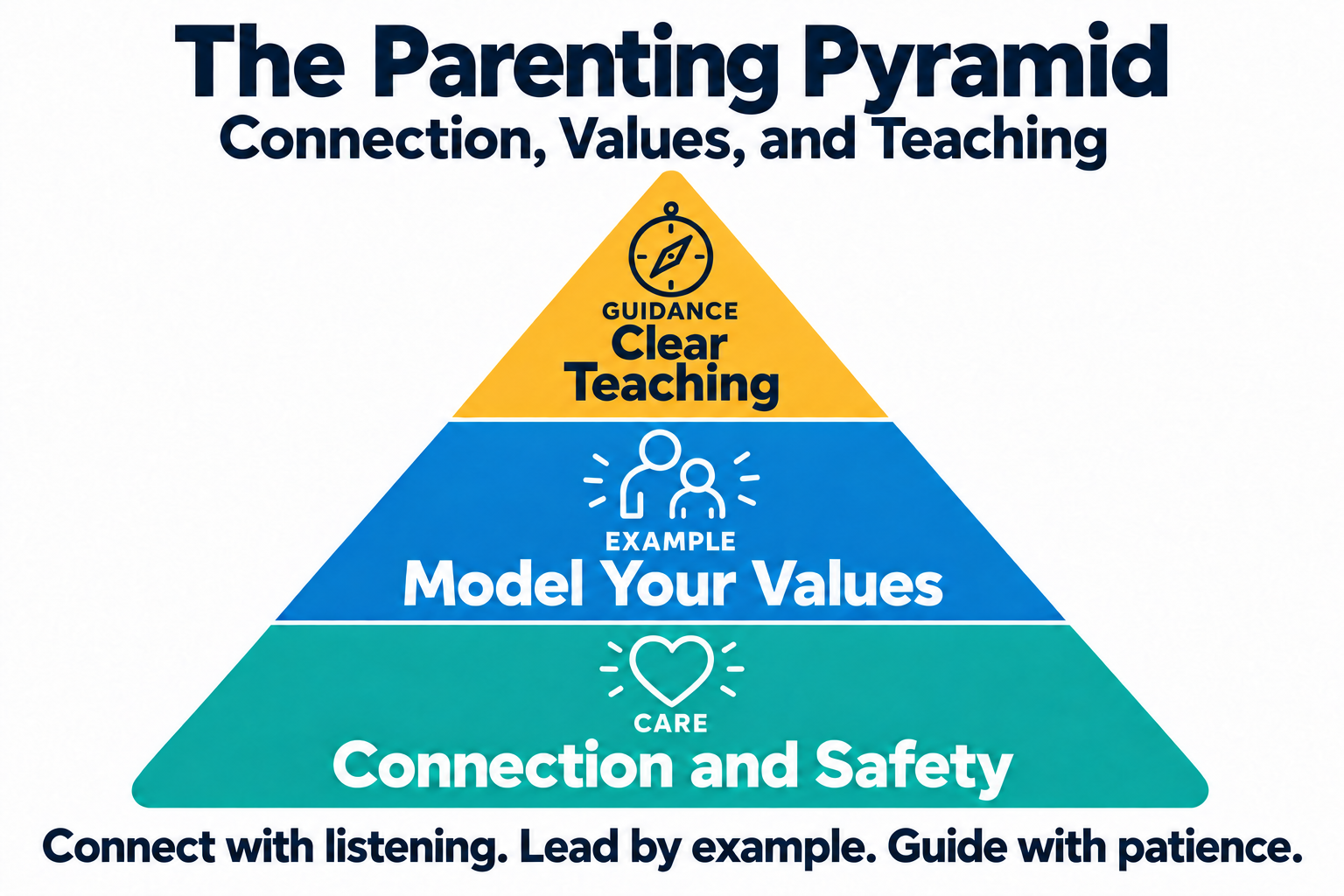
1. Take your place as the responsible adult
Young children need to know that parents are responsible for protection, teaching, household rules and discipline.
Offer choices within limits appropriate to their age, abilities and safety needs. They may choose whether to brush their teeth or put on pajamas first. Hitting is not an option, and aggression must not remove necessary responsibilities.
Children may express disagreement, but they cannot overturn rules by hurting others.
Parental authority grows through clear, reasonable and reliable leadership. When you say “No hitting,” act to stop it. Follow through on household rules consistently. Rules that disappear whenever a child protests are difficult to learn.
2. Love includes teaching children to accept limits
Children need understanding, and they also need to learn that everyone in the family has needs and boundaries and deserves respect.
If parents take “gentle discipline” to mean that they cannot say no to their children’s requests, intervene when their children misbehave, or hold to an expectation when their children cry or protest, that approach to discipline is ineffective. Children then struggle to learn important principles of behavior and miss opportunities to practice waiting, accepting limits and taking responsibility. Once you put a family rule into practice, follow through consistently so that it teaches what it was meant to teach.
Teach that wanting something does not mean getting it immediately; frustration does not permit harm; other people's needs matter too; and mistakes require repair and learning.
Understanding feelings does not mean allowing those feelings to set the rules for the whole family. Kindness and firm expectations can coexist.
3. When words do not stop hitting, act
If hitting continues, do not simply repeat “Don't” or wait for cooperation.
Block the blows, create a safe distance and speak clearly and firmly:
“Stop. No hitting.”
“I will not let you keep hitting me.”
If necessary, briefly block their hands using only the minimum force needed to prevent harm, releasing once the attack stops. Do not squeeze painfully, twist joints, pin the child down or shake them. Keep your footing, protect your face and move other children out of reach.
This is not the moment for a long lecture. First establish that harmful behavior is stopped immediately and bodily boundaries are protected.
If you are about to lose control, say: “I need a moment to calm down. We will deal with this when we are safe and calm.” Ensure safe supervision or ask another adult to take over. Return to the teaching afterward.
4. Follow through on the rule
Authority requires consistent action and consequences connected to the behavior:
- If hitting happens during play, pause that play immediately.
- If an object is used to hurt someone, put it away.
- If hitting is used to avoid brushing teeth or tidying, return to the reasonable task once everyone is safe and calm.
- After harm, teach concern for the person affected, an apology and appropriate repair.
Avoid repeatedly teaching that escalating resistance makes adults abandon the expectation.
Also check the expectation itself. If brushing hurts or a task exceeds the child's abilities, adjust your approach. Correcting your own methods is responsible leadership.
5. Understand your hurt and regain your ability to lead
Being hit may bring more than physical pain. It may stir the feeling that your care has gone unappreciated. You may feel sad or cry. Once calmer, return to the question: “How can I fulfill my responsibility as a parent now?”
If these feelings recur, reflect on your upbringing. Were your feelings taken seriously? Could you disagree? How did adults handle conflict? Did you learn that acceptance depended on compliance or constant giving?
These experiences may influence your responses today. Understanding them can expand your choices and help you practice new responses. You can care for the hurt parts of yourself while gradually building the ability to protect yourself and guide your child.
Separate “I am unworthy of love” from “My child needs teaching”
When your child hits you, you may think: “I do so much for them. Why am I being treated this way?”
Your effort deserves recognition, and you deserve respect. Your child's behavior in that moment does not mean all your parenting has failed, and it does not determine your worth.
Remind yourself:
“I am hurt right now, but I can still handle this.”
“My child has done something wrong and needs my guidance. Their response does not determine whether I deserve love.”
Children need to learn concern for others, acknowledgment of mistakes and repair. For deeper hurt, seek support from a partner, trusted adult or professional. Your recovery should not depend entirely on your child first apologizing or comforting you.
Caring for your feelings and fulfilling your parenting responsibilities can happen together. Distinguishing your hurt from what your child needs to learn helps you stop harm clearly and complete the teaching.
6. Let responsibility—not immediate approval—guide you
Consider whether your expectations are reasonable, your methods appropriate and your responsibilities fulfilled.
Your child may resent a limit or temporarily reject closeness. That does not mean necessary boundaries should disappear.
Keeping a child happy is not the same as fulfilling your role. Their immediate displeasure does not make reasonable discipline wrong.
Teach respect, appropriate expression, rules and responsibility through patient practice and your own example, without hitting to resolve conflict.
When your child wants to reconnect, welcome the approach while saying: “I am willing to make up. We still need to address the hitting.” Restore the relationship and complete the repair.
7. Adapt your role as your child grows
With young children, you are a protector, teacher, disciplinarian, rule-setter and playmate. Provide concrete examples and clear expectations.
During adolescence, increasingly become a guide, listener and counselor, allowing more participation in decisions and practice in judgment and accountability.
With adult children, move toward a friendship-like relationship of equality and respect, supporting sound choices while recognizing their responsibility for their decisions.
Your role changes, but the direction remains: from external limits toward self-discipline and responsibility.
8. Equip yourself and seek support
Raising children also means working on yourself. That inner work includes self-compassion and self-empowerment.
Self-compassion means recognizing how hard things are when you face a setback and giving yourself the same understanding you would offer a friend. Self-empowerment means identifying what you still need to learn, choosing one practical approach, and practicing it until you can use it the next time a difficulty arises.
Talk through approaches with your partner and share caregiving. If you keep getting stuck on the same problem, consider seeking professional support. Caring for yourself, continuing to learn, and asking for help when you need it can help you stay steady under pressure and become an adult your child can count on.
A reminder for parents
You are the adult responsible for guidance. Love includes teaching respect; understanding feelings includes stopping harm.
Build confidence one clear intervention, one consistently enforced rule and one completed teaching conversation at a time. You can learn to protect yourself and guide your child.
Related reading: When Your Child Hits in Anger